















Hive Management Services
Professional Beekeeping Hive Management Services
A colony may suddenly become defensive. Brood may not look right. The hive may need more space, supplementary feeding, a new queen or closer Varroa monitoring. Sometimes the problem is obvious. Other times, something simply does not look or feel right inside the hive.
Hornsby Beekeeping Supplies provides practical, on-site beekeeping management to help you deal with these situations directly at your apiary.
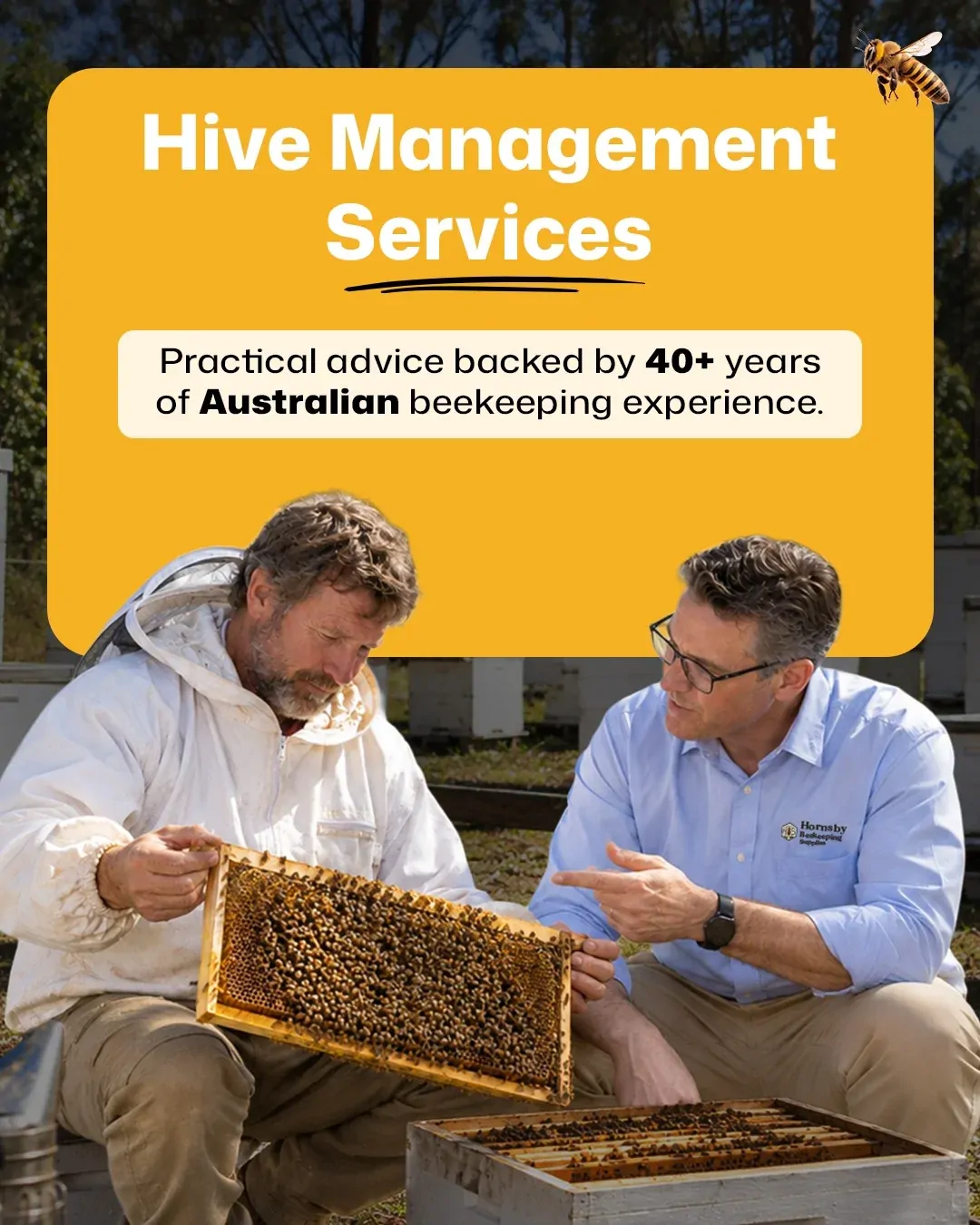
With more than 40 years of Australian beekeeping experience, our team can visit your hives, assess what is happening and help carry out the management work required.
Service rate: $150 per hour.
This is a hands-on, on-site beekeeping management service. It is not a phone, video or online consultation service.
Practical Hive Management at Your Apiary
Every colony is different.
Its condition can depend on the season, queen performance, available food, brood pattern, colony population, hive space, pest pressure and many other factors.
That is why practical hive management is best based on what is actually happening inside the colony.
During an on-site management visit, we can inspect the hive, assess the situation and help manage the work that needs attention.
Depending on your hive and circumstances, this may include routine management, brood assessment, queen management, supplementary feeding, seasonal preparation, Varroa management, honey management and other practical hive work.
Starting With Your First Hive
New to beekeeping?
The first few inspections can raise a lot of questions.
Rather than trying to work everything out alone, an on-site management visit allows an experienced beekeeper to work through the hive with you and help establish good management practices from the beginning.
Management may include:
- Checking your hive setup
- Inspecting frames
- Assessing colony activity
- Looking at brood development
- Checking available food stores
- Reviewing hive space
- Identifying equipment requirements
- Planning seasonal hive work
- Establishing a practical inspection routine
The aim is to help keep your hive properly managed while also giving you a clearer understanding of what is happening inside the colony.
Regular Hive Management
A healthy hive requires ongoing attention throughout the year.
Colony strength, brood production, honey stores and available space can change significantly between seasons.
Our regular hive management service can help assess:
- Colony condition
- Brood development
- Queen performance
- Food stores
- Hive space
- Pest pressure
- Equipment condition
- Seasonal requirements
- Upcoming management priorities
We can then help carry out the appropriate management work during the visit.
Managing Aggressive Bees
A colony that becomes unusually defensive can make routine hive work difficult and may create safety concerns around the apiary.
During an on-site visit, we can inspect the colony and assess factors that may be contributing to the behaviour.
Management may involve reviewing colony condition, queen performance, hive disturbance and other relevant factors.
Where appropriate, requeening or other queen-management steps may form part of the management plan.
Aggressive colonies should be approached carefully, particularly where hives are located near homes, neighbours, pets or frequently used areas.
Requeening & Queen Management
The queen plays a central role in colony development.
When queen performance declines or a colony requires a new queen, correct preparation and timing become important.
Our on-site queen management can help with:
- Assessing queen performance
- Checking brood patterns
- Identifying possible queen-related problems
- Preparing a colony for requeening
- Queen introduction
- Managing the hive after queen introduction
- Follow-up management requirements
The appropriate approach will depend on the condition and behaviour of the individual colony.
Brood Assessment & Management
Brood frames can reveal a great deal about the condition of a colony.
During hive management, we can assess brood development and look at the overall brood area in the context of the colony.
This may include checking:
- Brood pattern
- Colony development
- Available brood space
- Queen activity
- Food around the brood area
- General frame condition
- Changes requiring follow-up
Brood management may also involve reorganising suitable hive space or planning the next management steps according to colony development.
Supplementary Feeding When Required
Not every hive needs supplementary feeding.
Our approach remains simple:
When and if required.
During an on-site management visit, we can assess colony stores, seasonal conditions and colony development before deciding whether supplementary feeding should form part of the management plan.
Where feeding is appropriate, the type and method should suit the colony and the conditions at that time.
Feeding should support a genuine management requirement rather than becoming an automatic part of every hive inspection.
Spring Hive Management
Spring can bring rapid colony growth.
Brood production can increase, bee populations can expand and available hive space can disappear quickly.
Good spring management may include:
- Inspecting colony strength
- Assessing brood development
- Checking queen performance
- Reviewing food availability
- Adding hive space where required
- Preparing additional equipment
- Monitoring colony expansion
- Managing overcrowding
- Planning upcoming hive work
Managing growth early can make the rest of the season easier to control.
Varroa Management
Varroa is now an important part of routine Australian hive management.
Our on-site service can help you take a more organised approach to Varroa through practical monitoring and management.
This may include:
- Varroa monitoring
- Reviewing monitoring results
- Planning ongoing management
- Treatment considerations where appropriate
- Follow-up monitoring
- Record keeping
- Incorporating Varroa checks into routine inspections
Where registered Varroa treatments are required, current product directions and relevant Australian requirements must always be followed.
Varroa management should be treated as an ongoing part of colony care rather than a one-off task.
Honey Management
Good honey management is closely connected to colony strength, timing and available space.
During an on-site management visit, we can assess the hive and help manage practical decisions around honey production.
This may include:
- Assessing honey-super space
- Checking whether additional space may be required
- Reviewing colony strength
- Inspecting honey frames
- Planning harvest timing
- Managing hive space after harvest
- Preparing the colony for the next stage of the season
Honey supers should be managed according to what the colony is actually doing rather than simply following a fixed calendar.
Preparing for Honey Extraction
If your first harvest is approaching, there may be several practical decisions to make before frames are removed.
We can help assess the hive and prepare for the extraction process.
This may include checking which frames are suitable for removal, reviewing honey-super management and helping plan the hive work surrounding the harvest.
The aim is to make the transition from hive to extraction more organised while keeping the needs of the colony in mind.
Keep Better Hive Records
It becomes surprisingly difficult to remember every hive inspection once you are managing several colonies.
Which hive was requeened?
Which colony received supplementary feed?
When was the last Varroa check?
Which hive needed more space?
Good records make these questions easier to answer.
We can help you develop a practical record-keeping system covering:
- Inspection dates
- Queen management
- Brood observations
- Feeding
- Varroa monitoring
- Honey management
- Equipment changes
- Follow-up work
Good records make future management decisions easier because you can look back at what actually happened rather than relying on memory.
Improve Everyday Beekeeping Management
You do not need to wait until something goes seriously wrong before booking hive management.
Sometimes your colonies simply need routine attention from an experienced beekeeper.
An on-site management visit can help with:
- Inspection routines
- Hive organisation
- Equipment preparation
- Brood management
- Seasonal planning
- Queen management
- Record keeping
- General hive maintenance
- Good beekeeping practices
Regular management can also identify smaller issues before they develop into more difficult problems.
More Than 40 Years of Australian Beekeeping Experience
Beekeeping knowledge develops through years of opening hives, managing colonies and seeing how bees respond to changing seasons and conditions.
Hornsby Beekeeping Supplies brings more than four decades of Australian beekeeping experience to our hive-management service.
Our focus is practical.
We come to the hive, assess what is happening and help manage the work required.
Whether you have one backyard hive or several colonies, the management is based on the condition of the bees in front of us.
On-Site Beekeeping Management
This is a physical, on-site service.
We visit the location where your hive is kept so the colony and hive equipment can be assessed directly.
There are no phone-management sessions, video consultations or online consultation appointments included in this service.
The management work takes place at your hive.
Service rate: $150 per hour.
How Booking Works
Step 1 — Tell Us What You Need Help With
Complete the booking form and give us a brief description of your hive, number of colonies and the main issue you would like managed.
You do not need to diagnose the problem yourself.
Simply tell us what you have noticed.
Step 2 — Provide Your Apiary Details
Provide the address where the hives are located along with the number of hives and any useful information about the site.
This allows the visit to be organised around your hive location.
Step 3 — Choose Your Preferred Date & Time
Let us know your preferred appointment date and time.
The visit can then be arranged according to availability.
Step 4 — On-Site Hive Management
Our beekeeping team visits your hive and works through the management required.
The service is charged at $150 per hour.
What Can We Help Manage?
Our on-site beekeeping management service can cover practical areas including:
- First-hive management
- Routine hive management
- Aggressive bees
- Queen problems
- Requeening
- Queen management
- Brood management
- Brood assessment
- Supplementary feeding when required
- Spring management
- Varroa monitoring and management
- Honey management
- Preparation for honey extraction
- Record keeping
- Seasonal hive management
- General good beekeeping practices
If your issue does not fit neatly into one category, describe what you are seeing in the booking form.
Frequently Asked Questions
How much does beekeeping management cost?
Our on-site beekeeping management service is $150 per hour.
Is this an online consultation?
No.
This service is entirely focused on physical, on-site hive management. We visit your hive and help manage the issue directly.
Do you come to my hive?
Yes.
The service is carried out at the location where your hive is kept.
I do not know what is wrong with my hive. Can I still book?
Yes.
You do not need to diagnose the problem before booking.
Tell us what you have noticed, and we can inspect the hive and assess the situation during the management visit.
Can you manage more than one hive?
Yes.
Include the number of hives in the booking form so we know what is involved before the visit.
Management time is charged at $150 per hour.
Can you help with aggressive bees?
Yes.
We can inspect the colony and help manage the situation. Where appropriate, queen management or requeening may form part of the approach.
Can you help with requeening?
Yes.
Queen assessment, colony preparation, requeening and queen-introduction management can be addressed during an on-site visit where appropriate.
Can you help with Varroa?
Yes.
Varroa monitoring and management can form part of the service.
Where registered products are used, current product directions and applicable Australian requirements must be followed.
Can you help with supplementary feeding?
Yes, when and if required.
We can assess colony stores and conditions before deciding whether supplementary feeding is appropriate.
Should I upload photographs when booking?
Photos are optional but can be useful when providing initial information about the hive, equipment or visible issue before the visit.
Your Hive Does Not Have to Be Managed Alone
A hive can change quickly.
What looked straightforward at the last inspection can become a queen issue, brood concern, feeding problem, space problem, aggressive colony or Varroa-management challenge by the next visit.
You do not have to keep guessing what should happen next.
With more than 40 years of Australian beekeeping experience, Hornsby Beekeeping Supplies can come to your hive, assess what is happening and help carry out the practical management work required.
On-site beekeeping management is available at $150 per hour.
Get experienced help where it matters most — at the hive.