

















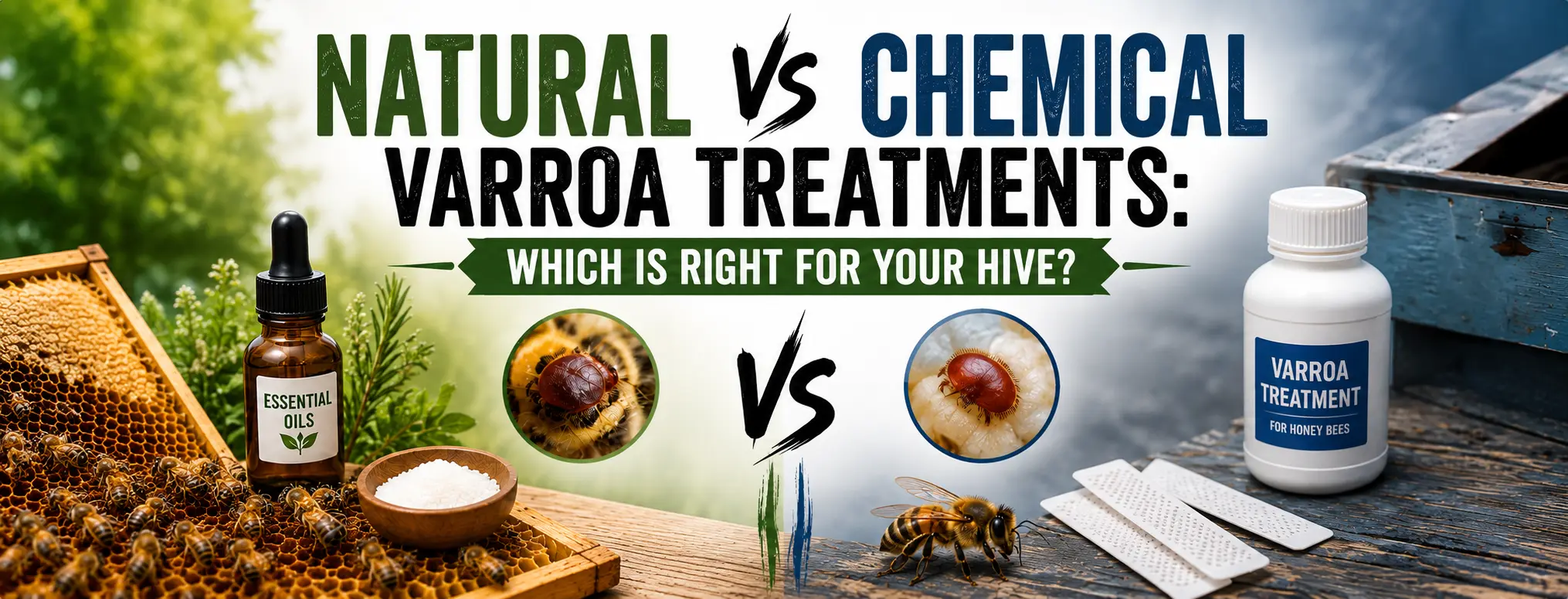
Natural vs Chemical Varroa Treatments: Which Is Right for Your Hive?
Author: Hornsby Beekeeping Date Posted:1 July 2026
Varroa mite management has become an essential part of modern beekeeping in Australia. For many years, Australian beekeepers did not have to manage Varroa in the same way as beekeepers overseas. However, with Varroa now part of the Australian beekeeping landscape in affected regions, beekeepers need to understand their treatment options carefully.
One of the most common questions is whether natural or chemical Varroa treatments are better. The answer is not as simple as choosing one side. Some treatments are based on organic acids or essential oil compounds, while others use synthetic miticides. Each option has strengths, limitations, timing requirements and safety instructions.
The best choice depends on your mite levels, colony strength, brood condition, season, honey super status, local rules and treatment history. This guide explains the difference between natural and chemical Varroa treatments and helps Australian beekeepers choose a more responsible management approach.
Why Varroa Treatment Choice Matters
Varroa mites are not just another hive pest. They feed on honey bees and reproduce in brood cells, which means their population can increase quickly if left unmanaged. More importantly, Varroa mites can weaken bees and spread viruses through the colony.
Because of this, Varroa control is not only about killing mites. It is about protecting the long-term health of the colony. A treatment that is used at the wrong time, in the wrong hive condition or without proper monitoring may fail to control mites and may also stress the bees.
Before choosing any treatment, beekeepers should ask three important questions:
-
What is the current mite level?
-
Is the colony strong enough for the treatment?
-
Is the product suitable for the season and hive condition?
This is why monitoring comes before treatment. Without a proper mite count, beekeepers may treat too early, too late or with the wrong product.
Start With Monitoring Before Any Treatment
The first step in Varroa management is testing the hive. Guessing is risky because mite levels are not always obvious from the outside. A colony can look active and still have a growing Varroa problem inside the brood nest.
Common monitoring methods include alcohol wash, soapy water wash and sugar shake. These methods usually use a standard sample of around 300 bees so that mite levels can be compared over time. Keeping the sample size consistent helps beekeepers make better decisions.
Monitoring helps you understand:
-
Whether Varroa is present
-
How mite levels are changing
-
Whether treatment is needed
-
Whether a previous treatment worked
-
Which hives need urgent attention
-
Whether reinfestation may be occurring
In areas where Varroa is established, regular monitoring should become part of normal hive management. In areas where Varroa is not yet established, surveillance is still important for early detection.
What Are Natural Varroa Treatments?
The term “natural treatment” can be confusing because all Varroa treatments involve active substances. In beekeeping, natural or organic-style Varroa treatments usually refer to products based on organic acids or essential oil compounds rather than synthetic miticides.
Common examples may include:
-
Formic acid products
-
Oxalic acid products
-
Thymol-based products
-
Some mechanical or brood-management methods used alongside treatments
These treatments can be useful, but they still need careful handling. Natural does not mean harmless. Organic acids and essential oils can affect bees, brood or queens if used incorrectly, especially during unsuitable temperatures or hive conditions.
For Australian beekeepers, the most important rule is to use only products that are legally permitted or registered for use in hives and to follow label directions exactly.
Benefits of Natural or Organic-Style Treatments
Natural or organic-style treatments are often attractive to beekeepers who want to reduce reliance on synthetic miticides. Some of these products can be useful in integrated pest management because they work differently from synthetic strips and may reduce the risk of resistance when used properly.
Possible benefits include:
-
Different modes of action from some synthetic treatments
-
Useful role in treatment rotation
-
Some options may be suitable in specific seasonal windows
-
Can support an integrated Varroa management plan
-
May appeal to beekeepers looking for softer treatment options
However, these benefits depend on correct product use. Temperature, brood levels, hive ventilation, colony strength and honey super status can all affect whether a treatment is suitable.
Limitations of Natural Treatments
Natural treatments are not automatically the best option for every hive. Some products are sensitive to temperature, meaning they may be unsafe or less effective during very hot or cold conditions. Others may work best when brood levels are low because many mites reproduce under capped brood.
Some natural or organic-style treatments may also require careful timing and repeat applications. If the beekeeper does not follow the instructions correctly, mite control may be incomplete.
Common limitations include:
-
Temperature restrictions
-
Possible queen or brood stress if misused
-
Reduced effectiveness when lots of capped brood is present
-
Need for correct dosage and timing
-
Strong odour or hive disturbance with some products
-
Risk of poor results if used casually
For this reason, natural treatments should still be treated as serious hive medications, not simple home remedies.
What Are Chemical Varroa Treatments?
Chemical Varroa treatments usually refer to synthetic miticides designed to kill mites inside the hive. These products are often highly effective when used correctly, especially when mite levels are high and urgent control is needed.
Examples of synthetic active ingredients used in Varroa management may include amitraz, fluvalinate and flumethrin products. These are often supplied as strips or similar treatment formats placed inside the hive for a specific period.
Chemical treatments can be powerful tools, but they also require careful use. Overuse, incorrect timing or repeated use of the same active ingredient can contribute to resistance. Residue management and label compliance are also important, especially around honey production.
Benefits of Chemical Treatments
Chemical Varroa treatments can be useful when mite levels are high and the colony needs reliable control. Many beekeepers choose them because they are familiar, practical and often easier to apply than some temperature-sensitive treatments.
Possible benefits include:
-
Strong mite control when used correctly
-
Practical application methods
-
Useful during serious infestations
-
Clear label instructions
-
Suitable for structured treatment plans
-
Often easier for beginners to understand than complex methods
For many beekeepers, chemical treatments are an important part of Varroa management. The key is to use them responsibly and not rely on one product repeatedly without monitoring results.
Limitations of Chemical Treatments
The main concern with synthetic chemical treatments is resistance. If the same active ingredient is used repeatedly, mites may become less susceptible over time. This can lead to treatment failure and higher mite levels in the hive.
There are also practical concerns around timing, residues and honey supers. Some products should not be used when honey supers for human consumption are on the hive. Others must remain in the hive for a specific period and then be removed according to the label.
Common limitations include:
-
Resistance risk if products are overused
-
Need to rotate active ingredients
-
Label restrictions around honey supers
-
Possible residue concerns if misused
-
Treatment failure if strips are removed too early
-
Reduced effectiveness if product is expired or stored poorly
Chemical treatments can work well, but only when they are part of a proper monitoring and rotation plan.
Natural vs Chemical: Which One Is Better?
There is no single best Varroa treatment for every hive. Natural and chemical treatments both have a place in modern beekeeping. The better question is: which treatment is right for this hive, at this time, under these conditions?
A natural or organic-style treatment may be suitable when mite levels are manageable, temperatures match product instructions and the beekeeper wants to include it as part of rotation. A chemical treatment may be more suitable when mite levels are high, fast control is needed and the product is appropriate for the hive condition.
The best choice depends on:
-
Mite count
-
Season
-
Brood level
-
Colony strength
-
Honey super status
-
Temperature
-
Previous treatment history
-
Local resistance concerns
-
Product availability
-
Legal label directions
In many cases, a good Varroa management plan may use both types over time, rather than relying only on one approach.
Understanding Integrated Pest Management
Integrated Pest Management, often called IPM, means using several strategies together instead of depending on one treatment. This is especially important for Varroa because resistance and reinfestation can make single-method control less reliable.
A good IPM plan may include regular monitoring, treatment rotation, strong colony management, brood breaks where appropriate, drone brood removal in some systems, screened bottom boards and responsible use of registered products.
An IPM approach helps beekeepers:
-
Reduce mite levels before they become dangerous
-
Avoid unnecessary treatments
-
Slow resistance development
-
Protect honey quality
-
Support stronger colonies
-
Track treatment success over time
IPM is not about avoiding treatments completely. It is about choosing the right action based on actual mite levels and hive conditions.
Mechanical and Management Options
Some beekeepers also use mechanical or management methods to reduce Varroa pressure. These methods may not be enough on their own during a serious infestation, but they can support a wider management plan.
Examples include:
-
Drone brood removal
-
Brood breaks
-
Queen caging where appropriate
-
Splitting colonies strategically
-
Screened bottom boards
-
Maintaining strong queens
-
Avoiding robbing and drifting
-
Monitoring after hive movement
These methods require skill and timing. For example, drone brood removal only works if it is done correctly and consistently. Brood breaks can reduce mite reproduction, but they may also affect colony build-up if poorly timed.
Mechanical methods should be used as supportive tools, not as a replacement for monitoring and treatment when mite levels are high.
Treatment Timing and Honey Supers
Treatment timing is one of the most important parts of Varroa control. Some products are not suitable when honey supers are on the hive. Others have temperature restrictions or require specific colony conditions.
Before applying any treatment, always check:
-
Is there capped brood?
-
Are honey supers on the hive?
-
What is the current temperature range?
-
Is the colony strong enough?
-
Is the queen healthy?
-
What does the label say?
-
When must the treatment be removed?
-
When should mite levels be checked again?
Incorrect timing can reduce effectiveness and may create honey contamination risks. For this reason, treatment planning should be done before the colony is in crisis.
Resistance and Product Rotation
Resistance is a major concern in Varroa management. When mites survive a treatment and continue breeding, future treatments may become less effective. Repeated use of the same active ingredient can increase this risk.
Product rotation means changing active ingredients across treatment cycles rather than using the same type again and again. However, rotation should be planned carefully. Simply changing brand names is not enough if the active ingredient or chemical group is similar.
To reduce resistance risk:
-
Monitor mite levels before and after treatment
-
Rotate active ingredients where appropriate
-
Follow label directions exactly
-
Do not underdose or overdose
-
Do not leave strips in longer than directed
-
Remove treatments on time
-
Avoid repeated use of the same active ingredient
-
Keep treatment records for every hive
Good records are essential. Without records, it is easy to forget what was used and when.
Choosing the Right Treatment for Your Hive
Choosing between natural and chemical Varroa treatments should be based on evidence from the hive, not personal preference alone. A beekeeper may prefer natural treatments, but if mite levels are dangerously high, a stronger or more reliable option may be needed. Similarly, chemical treatments should not be used automatically if monitoring shows mites are below action levels.
A practical decision process is:
- Monitor the hive using a recognised method.
- Record the mite count.
- Check colony strength and brood status.
- Review the season and weather conditions.
- Check whether honey supers are on the hive.
- Review previous treatments and resistance risk.
- Choose a legally approved treatment.
- Follow label instructions exactly.
- Recheck mite levels after treatment.
- Record results for future planning.
This process helps prevent guesswork and supports better colony health.
Common Mistakes to Avoid
Many Varroa treatment problems come from poor timing, weak monitoring or incorrect product use. Even a good product can fail if it is used in the wrong conditions.
Avoid these common mistakes:
-
Treating without checking mite levels
-
Assuming natural treatments are risk-free
-
Using unapproved home remedies
-
Leaving strips in too long
-
Removing treatments too early
-
Treating with honey supers on when the label does not allow it
-
Repeating the same active ingredient without rotation
-
Ignoring temperature restrictions
-
Forgetting to retest after treatment
-
Failing to keep treatment records
Varroa management is not a one-time job. It is an ongoing part of responsible beekeeping.
Varroa Treatment Checklist for Australian Beekeepers
Use this checklist before applying any Varroa treatment:- Confirm mite levels with a proper test
- Check current Australian rules and product approval
- Read the product label carefully
- Check temperature requirements
- Confirm honey super restrictions
- Assess colony strength and queen status
- Record the treatment date and product used
- Apply the correct dose
- Remove the product at the required time
- Retest after treatment
- Rotate active ingredients where appropriate
- Keep all records for future inspections
Final Thoughts
Natural and chemical Varroa treatments both have a role in Australian beekeeping. Natural or organic-style options can be useful in the right conditions, especially as part of an integrated pest management plan. Chemical treatments can provide strong control when mite levels are high or when reliable intervention is needed.
The right choice depends on your hive, mite count, season, brood level, honey super status, local resistance concerns and product instructions. The most important rule is to monitor first, treat responsibly and keep accurate records.
For Australian beekeepers, Varroa management should not be based on guesswork. A good plan combines monitoring, suitable treatments, product rotation, strong colony management and regular follow-up checks.
If you need swarm collection equipment, nucleus boxes, protective clothing, or expert beekeeping advice, Hornsby Beekeeping Supplies is here to help. Contact our experienced team on 02 9477 5569 or email info@hornsby-beekeeping.com for trusted products and practical beekeeping support across Australia.
FAQs
Are natural Varroa treatments safer than chemical treatments?
Natural or organic-style treatments can be useful, but they are not automatically risk-free. Products such as organic acids and essential oils still need correct dosing, timing and temperature conditions.
What are common natural Varroa treatment options?
Common natural or organic-style options may include formic acid, oxalic acid and thymol-based products. Australian beekeepers should only use products that are legally permitted or registered for hive use.
What are chemical Varroa treatments?
Chemical Varroa treatments usually refer to synthetic miticides such as amitraz, fluvalinate or flumethrin products. They can be effective when used correctly, but resistance management is important.
Should I treat for Varroa without testing?
No. Testing helps confirm mite levels and shows whether treatment is needed. Treating without monitoring can lead to unnecessary product use or missed infestations.
Can I use Varroa treatments with honey supers on?
It depends on the product. Some treatments have restrictions around honey supers. Always read and follow the label before applying any treatment.
Why is treatment rotation important?
Rotation helps reduce the risk of mites developing resistance to one active ingredient. It also supports a stronger integrated pest management plan.
Are mechanical methods enough to control Varroa?
Mechanical methods such as drone brood removal or brood breaks can help reduce mite pressure, but they may not be enough during serious infestations. They work best as part of a wider management plan.